
That Frustrating Moment When Your Garage Door Won't Stay Closed
You press the button on your remote, the garage door starts its descent, and then — just before it reaches the floor — it reverses and goes right back up. You try again. Same thing. Maybe it works on the third attempt, maybe it doesn't. Either way, you're standing in your driveway in Spanish Fork wondering what just happened.
This is one of the most common garage door problems we get calls about, and the good news is that it's usually fixable without replacing the entire door. The bad news is that ignoring it can leave your garage wide open to weather, pests, and security risks. Let's walk through the most likely causes and what you can do about each one.
The Safety Sensors Are Misaligned or Blocked
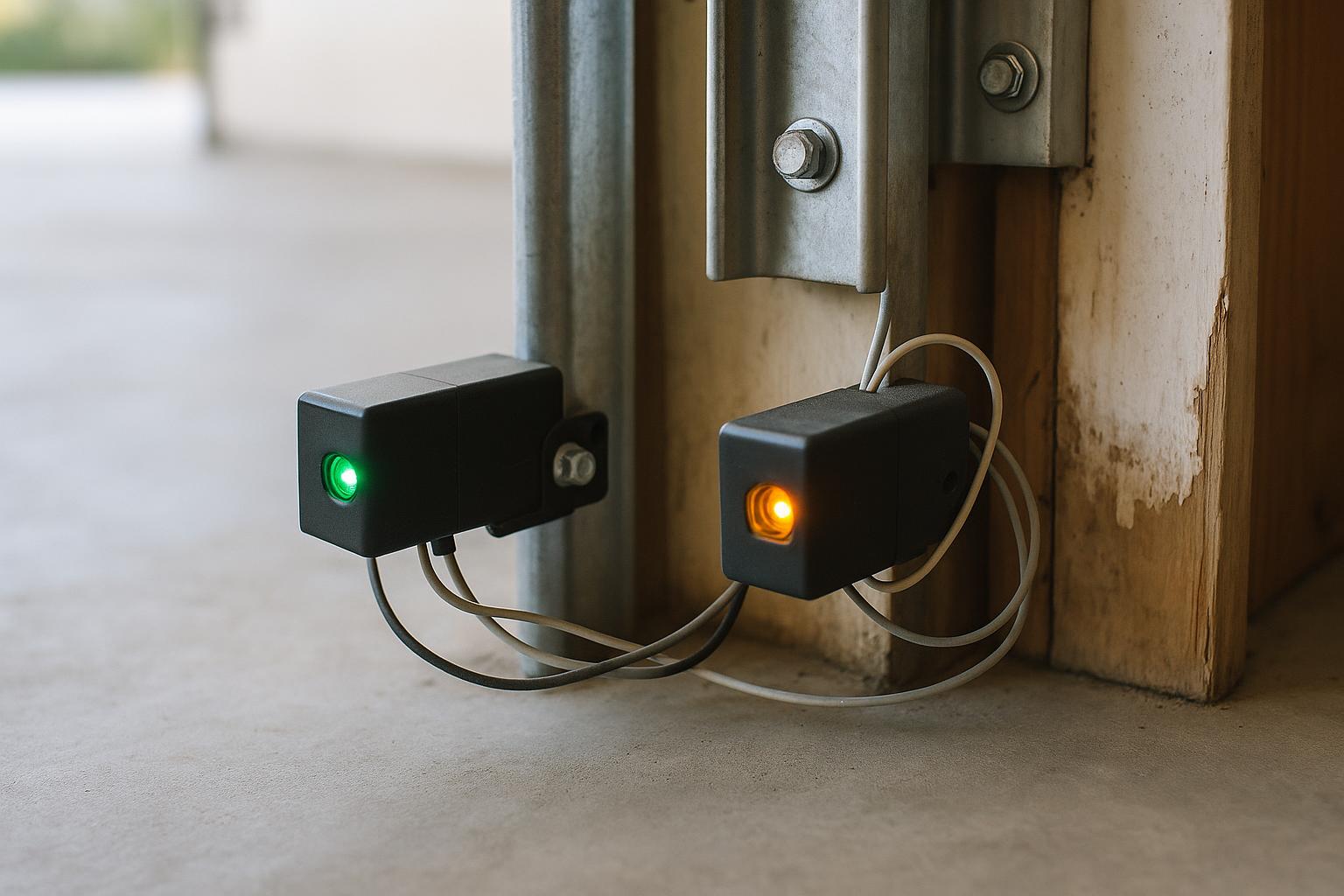
This is the number one reason garage doors reverse before closing. Every garage door opener manufactured after 1993 is required to have photo-eye safety sensors — two small devices mounted near the bottom of the door tracks on either side. They send an invisible beam across the opening, and if anything breaks that beam, the door reverses to prevent crushing a person, pet, or object.
Here's what to check:
- Look for obstructions. A broom, a shoe, a trash can, or even a cobweb can block the sensor beam. Clear anything near the sensors and try again.
- Check the alignment. Each sensor has a small LED light. If one is blinking instead of staying solid, the sensors are likely out of alignment. Gently adjust the sensor that's blinking until both lights are steady.
- Clean the lenses. Dust, dirt, and spider webs accumulate on the sensor lenses over time, especially in garages that see a lot of use. Wipe them down with a soft cloth.
- Check the wiring. If the sensor wires are frayed, pinched, or disconnected, the opener won't receive the signal it needs to allow the door to close. This is one situation where calling a professional makes sense.
The Close-Limit Switch Needs Adjusting
Your garage door opener has a setting called the close-limit switch (sometimes called the travel limit). This tells the opener how far the door needs to travel before it's fully closed. If this setting is off — even by a small amount — the opener may think the door has hit an obstruction when it actually hasn't, causing it to reverse.
This commonly happens after a spring replacement or when a new opener is installed and the limits aren't dialed in precisely. On most openers, you'll find small adjustment screws on the back or side of the motor unit. Turning the close-limit screw in small increments can solve the problem, but you need to be careful not to overdo it. Setting it too far can cause the door to press too hard against the floor, which puts unnecessary strain on the opener and the door itself.
If you're not comfortable making this adjustment, it's a quick fix for any experienced garage door technician in the Spanish Fork area.
The Tracks Are Dirty, Bent, or Misaligned
Your garage door rides along metal tracks on both sides. If those tracks are bent, clogged with debris, or have shifted out of alignment, the door can bind or stick partway down. When the opener senses that resistance, it treats it like an obstruction and reverses.
Run your eye along the tracks from top to bottom. Look for:
- Visible dents or bends in the metal
- Gaps between the track and the wall or ceiling
- Buildup of grease, dirt, or small objects inside the track
You can clean the tracks yourself with a damp cloth and check that the mounting brackets are tight. However, if the tracks are visibly bent or pulled away from the wall, don't try to hammer them back into shape. Improper track repair can make the problem worse and create a safety hazard. That's a job for a professional.
Worn or Broken Springs Are Creating Uneven Movement
Garage door springs do the heavy lifting — literally. They counterbalance the weight of the door so the opener doesn't have to work as hard. When a spring is worn, weakened, or broken, the door becomes much heavier on one side or overall. The opener struggles, senses excessive resistance, and reverses.
Signs that your springs might be the problem include:
- The door feels unusually heavy when you try to lift it manually
- The door looks crooked or uneven as it moves
- You heard a loud bang from the garage (a common sign of a spring breaking)
- There's a visible gap in one of the torsion springs above the door
Spring replacement is not a DIY job. These springs are under extreme tension and can cause serious injury if handled incorrectly. If you suspect a spring issue, call a qualified garage door company to handle the repair safely.
The Opener Force Settings Are Too Low
In addition to travel limits, most garage door openers have force settings that control how much power the motor uses to open and close the door. If the close force is set too low, the opener may not have enough power to push the door all the way down, especially if the door is older, heavier, or the weather has changed.
Here in Spanish Fork, temperature swings between seasons can actually affect how your garage door operates. Cold weather can thicken lubricant and make weatherstripping stiffer, which increases the resistance the door encounters on the way down. A slight adjustment to the force setting can often resolve this seasonal issue.
Again, small adjustments are key. Cranking the force too high defeats the purpose of the safety reverse feature, which exists to protect your family.
When to Call a Professional
Some of these fixes — cleaning sensors, clearing obstructions, wiping down tracks — are perfectly reasonable for a homeowner to handle. But if you've gone through the basics and the door is still reversing, or if the problem involves springs, tracks, or wiring, it's time to call in help.
At Spanish Fork Garage Door, we diagnose these kinds of issues every week for homeowners across Spanish Fork, Springville, Salem, Payson, and the surrounding area. We show up on time, figure out what's actually wrong, and fix it at a fair price — no upselling, no unnecessary part replacements.
Don't Leave Your Garage Open to Chance
A garage door that won't close isn't just annoying — it's a security risk and an energy waste, especially during Utah's cold winters. If your door keeps reversing and you can't pinpoint the cause, give us a call. We'll get it sorted out so you can get back to pressing the button once and walking away, the way it's supposed to work.